
Retrained scoring service
Built on a documented feature set every score can be traced through.
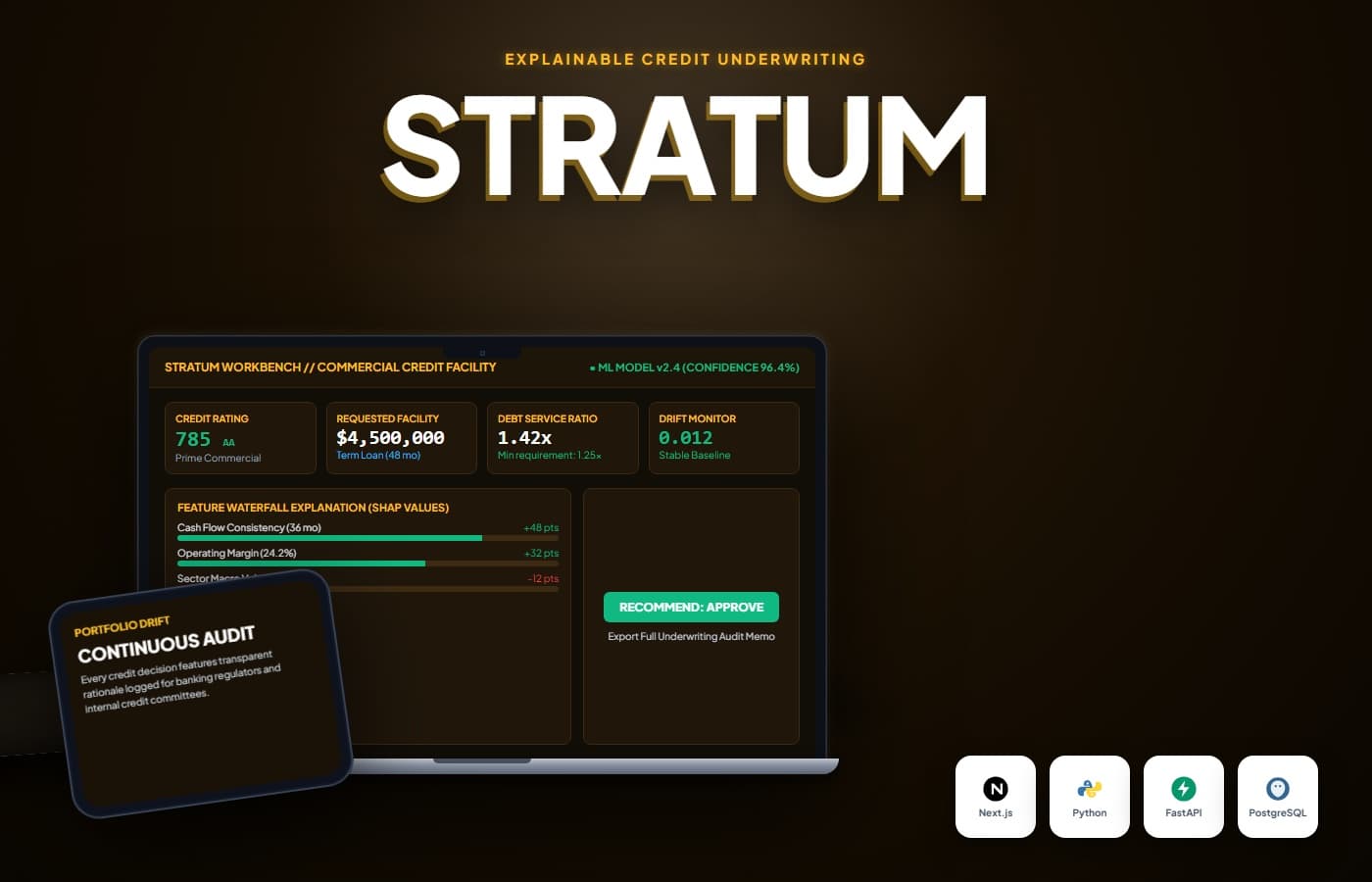
A fullstack credit-risk workbench rebuilt with explainability as a screen, not a footnote — underwriters see the reasoning behind every score where the decision happens.
Start a ProjectThe prior scoring model was accurate but couldn't say why it reached a number, so underwriters overrode it on instinct more often than not. Accuracy that never survives contact with a decision isn't really accuracy — it's a suggestion nobody trusted enough to follow.
Rather than retrain the model and hope trust followed, we treated explainability as a first-class screen, not a report generated after the fact. The scoring service was rebuilt on a documented feature set specifically so its reasoning could be rendered next to the score, at the moment the underwriter needed it.
A retrained scoring service with a documented, traceable feature set, a case-level explainability panel rendered beside the score in the workbench, and a monitoring pipeline that flags drift before it reaches a lending decision.

Built on a documented feature set every score can be traced through.
The reasoning behind a score sits next to it, not three clicks away.
Every input to a score is named, sourced and reviewable.
Flags a model drifting off its training distribution before it lends badly.
Score, trace and case history in one screen, not three systems.
Every underwriter override is logged against the score it overrode.

The client-side architecture and interface layer shipped for this engagement.

Services, APIs, and business logic running the system end to end.

Datastores and pipelines chosen for this engagement's consistency and throughput needs.

Deployment, orchestration, and delivery tooling running the platform in production.

Tracing a score without adding latency to the decision
Computing a full explainability trace at request time risked slowing every application review. Feature contributions are precomputed alongside the score itself, so the trace is a lookup, not a second inference pass.
Retraining without breaking the explainability contract
A retrained model could silently drop or rename a feature the workbench's trace view depended on. The feature set is versioned and validated against the workbench's contract before any retrained model can deploy.
Catching drift before it reaches a lending decision
Model drift is invisible until it shows up in bad loans months later. A monitoring pipeline compares live feature distributions against training data daily and flags a model for review before it drifts far enough to matter.
2 weeks
Shadowed underwriters to see exactly where they stopped trusting the old model's number.
2 weeks
The documented feature set was scoped before a single line of the scoring service was written.
2 weeks
The explainability panel was designed to sit beside the score, never behind a second click.
6 weeks
Scoring service and workbench UI built against the same feature contract simultaneously.
3 weeks
Backtested against a year of prior decisions to confirm the new score matched sound overrides.
1 week
Rolled out to one underwriting team first, expanded once override rates dropped.

“Underwriters stopped overriding the model out of habit. They can finally see what it saw.”
Yuki Tanaka · Director of Engineering · Stratum




Technical briefingNot a sales desk