

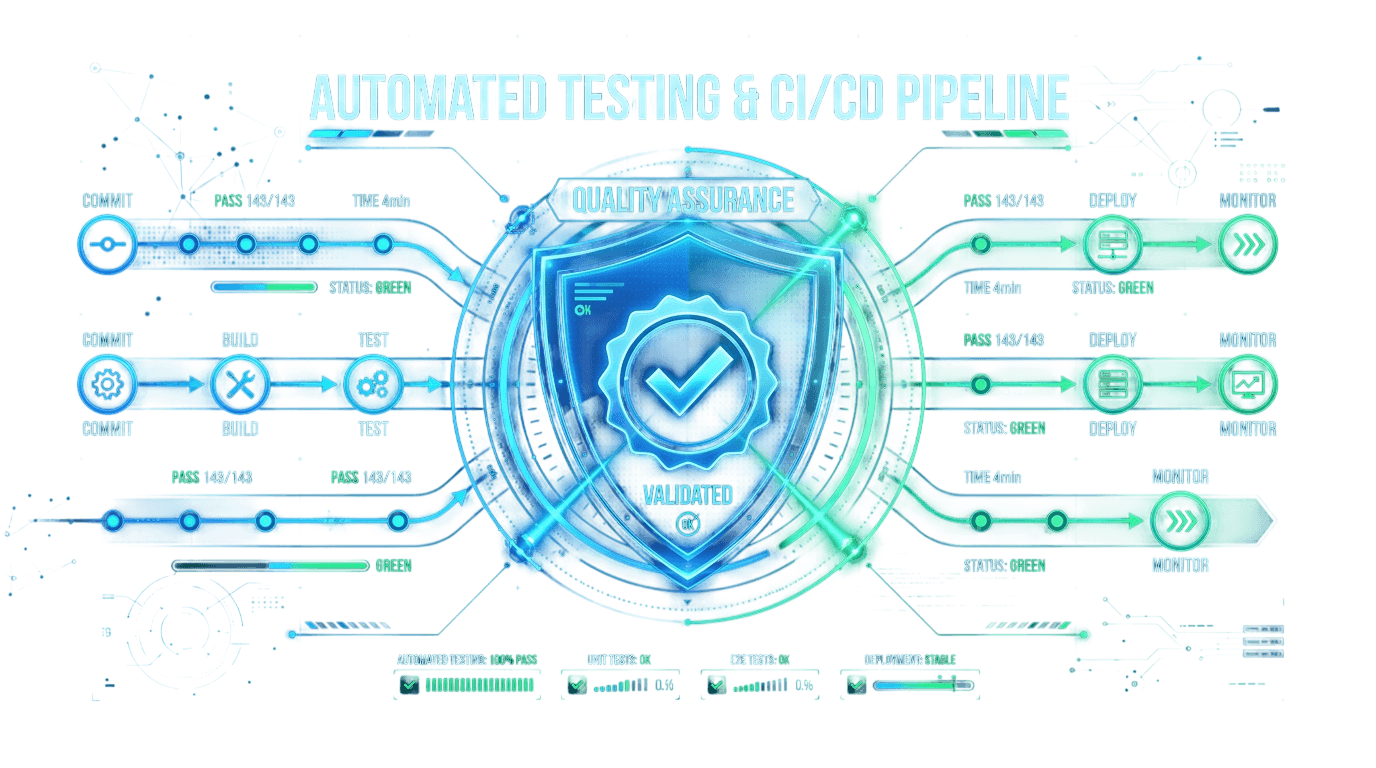
Quality & Automation006
The tests, gates and pipelines that let a team release on a Friday — coverage where failure is expensive, not coverage for its own sake.
- E2E suite
- CI gates
- Load testing
- Release automation
Whether you're a rising startup or an established name, we engage this service the same way we engage every other one — a diagnostic before a proposal, and a shipped result measured against what we said it would do.
Service Overview
We build the tests, gates and pipelines that let a team release on a Friday without dreading Monday — coverage where a failure is expensive, not coverage chased for its own sake or a dashboard number.
Every gate we add exists because a specific failure mode is worth catching before production, and every one we skip is a deliberate call, not an oversight — so the suite a team inherits is one they trust rather than one they route around.
Client Goals
Give the team a release gate they trust enough to deploy at the end of the week, not one they schedule around out of fear.
Put test effort against the paths where a bug actually costs the business money, not against every line for the sake of a percentage.
Make CI results something engineers act on immediately, not a flaky gate they've learned to re-run and ignore.
What Every Engagement Gets
Four commitments that hold the same way on every project, regardless of scope or budget.
Risk-Based Test Strategy
Coverage is prioritised by what a failure actually costs, not by chasing a percentage.
CI Gates That Are Trusted
A red pipeline blocks a merge because the team believes the failure is real, not because policy says so.
Load Tested Before Launch
Traffic patterns are simulated against the system before real users find its limits first.
Incident Runbooks Ready
When something does fail in production, the response is already written down, not improvised.
Tech Stack
The same toolkit behind every service, chosen for the discipline it enables.

Cloud-native compute, declarative orchestration, and global edge routing engineered for zero-downtime scalability.

Type-safe, memory-efficient languages and low-latency runtimes selected for high concurrency, fast startup, and long-term maintainability.

Relational, document, and distributed event streaming datastores tuned for strict ACID guarantees, high throughput, and replication.

Production-grade vector indexing, evaluation harnesses, and cognitive retrieval pipelines backing intelligent enterprise systems.

Automated CI/CD pipelines, end-to-end testing harnesses, and real-time observability telemetry guarding production releases.
Questions on quality & automation work.
No — coverage is prioritised by what a failure actually costs. We map test effort to the paths where bugs hit the business hardest, and treat a lower overall percentage with the right cases as better than a high number full of tests nobody trusts.
Flakiness is treated as a defect in the suite, not a re-run problem. Root causes — shared state, timing assumptions, unstable environments — are fixed at the source so a red pipeline means something the first time.
Yes — most engagements inherit a suite the team has learned to route around. We audit what is actually catching bugs, retire what is not, and rebuild coverage around the failure modes worth catching before production.
Gated pipelines, environment parity, seeded staging data and a rehearsed rollback path — so shipping is a routine operation the team trusts, including on a Friday, rather than a scheduled event everyone tenses up for.
Technical briefingNot a sales desk